
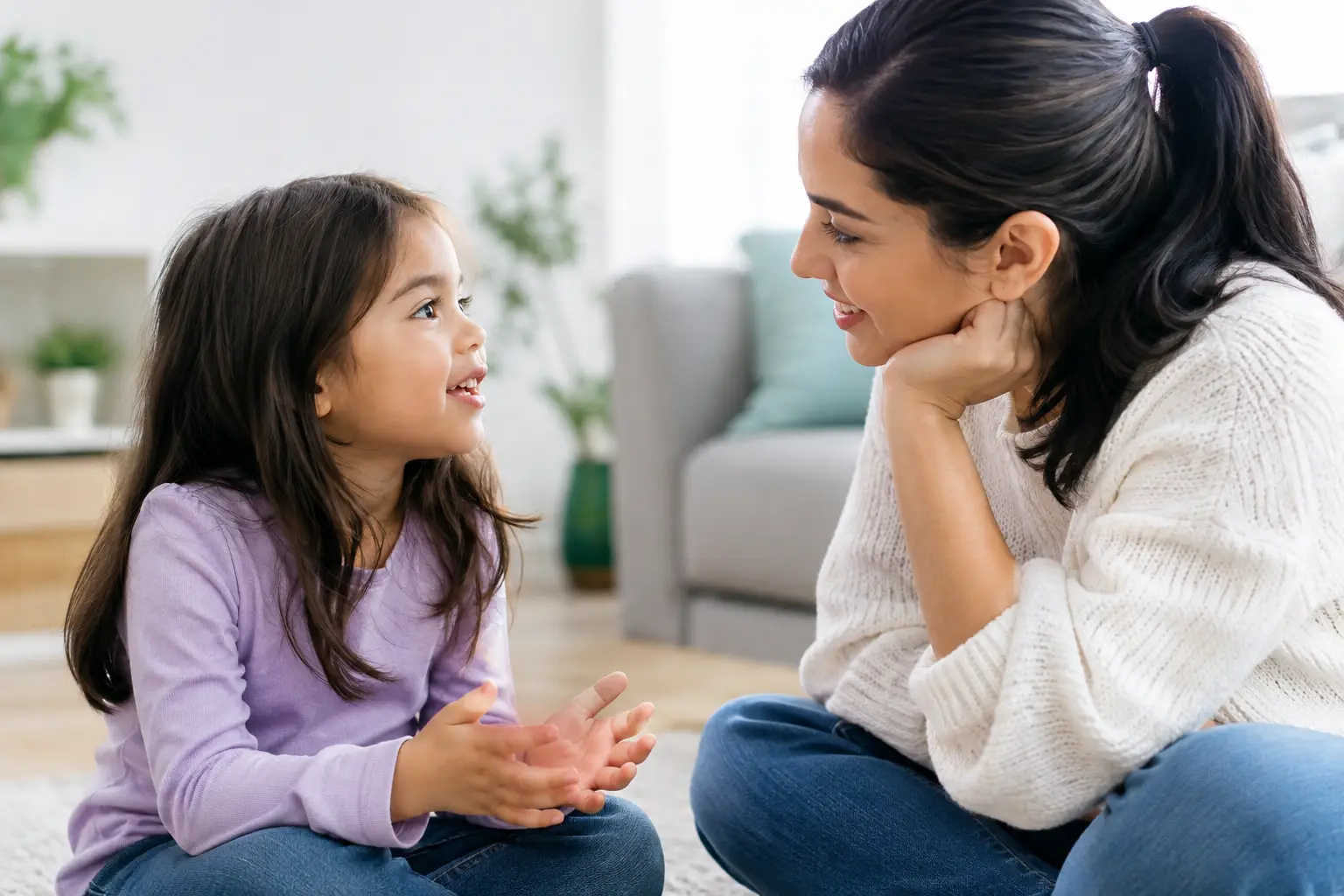
A child says, “Nobody wanted to play with me,” and an adult quickly answers, “I’m sure that’s not true.” The adult means to comfort. But the child may hear something else: “Your feeling is too big, or too inconvenient, to stay with.”
To teach active listening to young children, we first have to let them experience it. When children are heard with patience, they begin to understand that listening is more than waiting for a turn to speak. It is a way of saying, “Your thoughts matter to me. I want to understand.”
That lesson belongs in ordinary moments: during a bedtime story, after a disagreement over blocks, on the walk home from school, or when a child notices that someone looks different from them. These are the moments when little kids have big questions – and when caring adults can help them practice curiosity, empathy, and connection.
What active listening looks like for children
Active listening is giving someone your attention so you can understand not just their words, but also what they may be feeling. For a preschooler, this can begin with a simple habit: looking at the speaker, keeping their body still for a moment, and waiting until the person is done before responding.
For an older child, active listening grows to include reflecting back what they heard, asking a kind follow-up question, and recognizing another person’s point of view even when they do not agree. A child might say, “You were sad because I changed the game,” or, “Did that make you feel left out?”
Children do not need to perform perfect eye contact or sit completely motionless to be good listeners. Some children listen best while drawing, holding a small object, or moving gently. The goal is not obedience disguised as listening. The goal is attention with care. Look for signs that a child is following the speaker’s meaning, then help them name what they noticed.
Teach active listening by letting children feel heard
Children learn relational skills by watching what happens around them. If they are regularly interrupted, rushed, or corrected before they can finish, they may copy those patterns with siblings and friends. If adults pause, listen, and respond thoughtfully, children receive a living example of how respect sounds.
Try beginning with a small pause. When a child tells you something, resist the urge to solve it immediately. Take a breath and offer a reflection first: “It sounds like you felt nervous when it was your turn,” or “You really wanted Grandma to see what you made.” A reflection does not have to be perfect. It simply tells the child you are trying to understand.
Then make room for them to add more. “Is that right?” is a powerful question because it gives the child authority over their own experience. They may say yes, correct you, or suddenly find more words. Each response helps them see that feelings can be named, explored, and shared safely.
It also helps to show that listening has a body. Turn toward the child when possible. Put the phone aside. Soften your face. In a busy classroom or family home, constant full attention is not realistic. Still, even a brief, genuine moment of presence can make a difference. You might say, “I want to hear this carefully. Give me two minutes to finish stirring, and then I will sit with you.” The key is to follow through.
Use stories as a gentle listening practice
Stories create a comfortable little bit of distance. A child may find it hard to talk directly about their own jealousy, worry, or confusion. They may find it much easier to talk about a character who felt those things. That is why shared reading can become a natural place to practice listening.
Before opening a book, invite a simple agreement: “Let’s listen for what the characters might be feeling.” You are not turning the story into a test. You are giving children a playful purpose for paying attention.
As you read, pause at meaningful moments. If a character is standing apart from the group, ask, “What do you notice about their face or body?” If another character responds with kindness, ask, “What do you think they heard or understood?” Let children point to the illustrations, make a guess, or disagree with one another. Their observations do not need to match yours to be valuable.
After the story, choose one or two questions that invite reflection rather than a correct answer. For example:
- “What part made you stop and think?”
- “How do you think that character wanted others to listen?”
- “Have you ever felt something a little like that?”
- “What could a friend say that would help?”
A book such as Two Me’s For Little Monk can support this kind of conversation because its story invites children to notice difference, shared feelings, and the ways people come to understand one another. The hidden-character search can also give younger children a welcoming way to stay engaged while the group talks. Not every child will want to speak right away. Looking, finding, and listening are meaningful forms of participation, too.
Help children respond instead of react
Listening is most challenging when feelings are loud. A child who feels accused, excluded, or disappointed may want to argue before they understand what happened. That is normal. The skill develops slowly, especially when children are tired, hungry, excited, or overwhelmed.
In those moments, give children a short phrase they can use as a bridge. “So you mean…” helps them check what they heard. “Tell me more” gives the other person room to explain. “I hear that you didn’t like it” acknowledges a feeling without requiring agreement.
Role-play can make these phrases feel less formal. Use stuffed animals, toy animals, or two characters from a familiar story. One animal can say, “I was using that!” The other can practice replying, “You were still using it. I didn’t know.” Keep the scene brief and a little playful. Children are more likely to use a new skill when they have tried it in a low-stakes moment.
For elementary-aged children, add the idea that listening and agreeing are different. They can say, “I understand why you were upset,” while still holding a boundary or offering another view. This is an important lesson in fairness and coexistence. Understanding someone’s feelings does not mean every choice is okay. It means every person deserves to be heard with dignity.
Make space for different communication styles
Some children tell long, winding stories. Others answer with one word. Some need time before they know what they feel. A child who says, “Nothing,” may be protecting a feeling they cannot yet explain. Pressing for a deeper answer can close the door.
Instead, offer a gentle opening: “Okay. If you want to tell me later, I will listen.” You can also give choices: “Would you rather talk, draw it, or show me with the feeling faces?” For children who are still building language, pictures, movement, and pretend play can carry meaning that words cannot yet hold.
Group settings call for care as well. In a classroom, some children raise their hands quickly while others need more time to form a thought. After asking a question, wait longer than feels natural. A quiet pause tells children that fast answers are not the only answers. Invite them to turn to a partner before sharing with the group, especially when the topic involves feelings, difference, or a personal experience.
Notice the small signs of growth
A child may not announce, “I am becoming an active listener.” Growth often appears in small moments: they wait while a sibling explains, ask a friend why they are sad, or say, “I didn’t know you felt that way.” Notice those moments out loud.
Rather than praising only compliance, name the caring action. “You listened until your brother finished. That helped you understand what he needed.” This connects listening with its real purpose: building trust between people.
Children will interrupt, misunderstand, and need reminders. Adults will too. What matters is returning to the conversation with kindness. Each time a child sees that people can pause, listen again, and repair a hard moment, they learn something lasting: being heard is part of belonging, and offering that gift to someone else is one way to make room for a kinder world.
Would Love to Hear What You Think!