
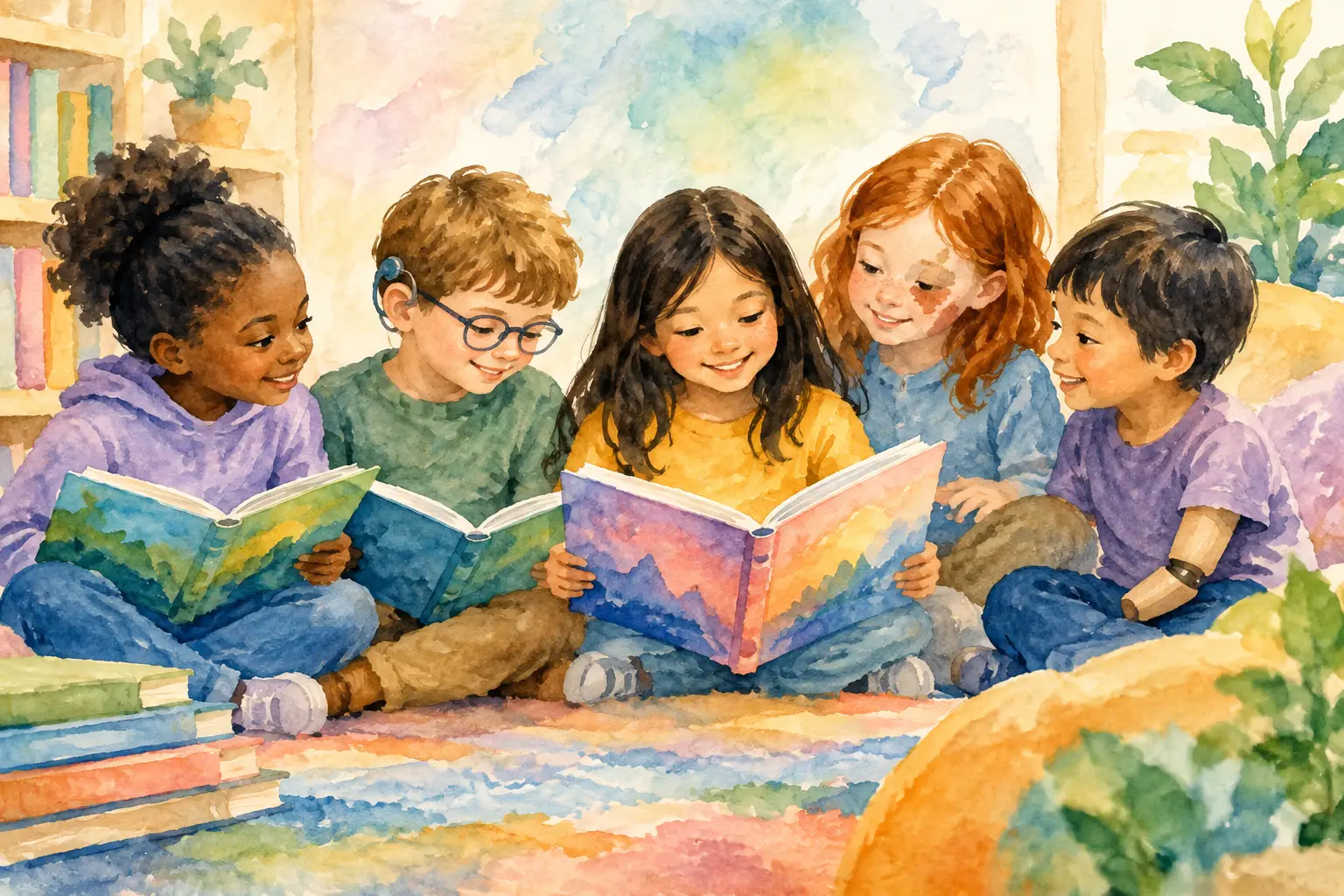
A child may notice a wheelchair, a facial birthmark, a hearing aid, a different skin tone, or hair that looks unlike their own long before they have the words to talk about it kindly. Their question might arrive in a grocery store whisper or halfway through story time: “Why does that person look like that?” Little kids have big questions. The right books about visible differences for children give adults a calm place to meet those questions with honesty, warmth, and respect.
A meaningful story does not ask children to pretend differences are invisible. It helps them see the whole person beyond a single feature. It can make room for curiosity while teaching that every person deserves dignity, friendship, and the freedom to be more than someone else’s question.
What These Stories Can Do Well
Children’s books are often called mirrors and windows. A mirror lets a child recognize something of themselves: “That character has a scar like mine,” or “Her family talks like my family.” A window offers a glimpse of an experience the child may not know personally. Both matter, and a well-chosen book can sometimes be both at once. A child may not share a character’s visible difference but may understand the wish to belong, the sting of being stared at, or the comfort of a good friend.
The strongest stories do not turn a child’s appearance into a problem waiting to be solved. A character who uses crutches can be brave, funny, impatient, inventive, worried about a school project, and loved by their family. A character with a birthmark does not need to spend every page learning to be “fixed” by someone else’s approval. Their difference may be part of the story, but it should not be the whole story.
This is where fiction can do quiet, lasting work. Instead of delivering a lecture about acceptance, a story lets children care about someone. When they care, empathy becomes more than a rule. It becomes a feeling they can carry into the classroom, playground, library, and neighborhood.
Choosing Books About Visible Differences for Children
Start with the child in front of you, not just the age range on the cover. Preschoolers often benefit from clear illustrations, simple emotional moments, and a reassuring rhythm. They may be especially ready to talk about what they notice: expressions, clothing, assistive devices, and how characters include one another in play.
Elementary-age children can usually hold more complexity. They may be ready to consider fairness, teasing, assumptions, and why a person might feel tired of being asked the same question. They can also begin to understand that two people with a similar visible difference may feel very differently about it. There is no single “right” way to experience identity.
Look for books in which the character has agency. Do they make choices? Do they have meaningful relationships? Are they allowed to feel more than grateful, cheerful, or inspirational? These details help children understand that respect means seeing people as full human beings, not as symbols of courage.
Illustrations deserve attention, too. Young readers take visual cues seriously. Notice whether characters with visible differences are drawn with care, included naturally in group scenes, and shown participating in everyday life. A book can have a kind message and still rely on images that isolate one child from everyone else.
It also helps to consider what role you hope the book will play. Some books offer a child a needed reflection of their own life. Others prepare a class to welcome many kinds of people. Still others open a conversation after a child has witnessed teasing or asked a direct question. One book rarely carries every need, so a varied shelf is gentler and more useful than searching for a single perfect title.
Representation Is Not a Lesson Plan
A story featuring visible difference does not need to end with a tidy moral. Real life is not always tidy. Sometimes a character may feel proud; another day, they may feel frustrated. Sometimes friends respond beautifully; sometimes they need to learn. Leaving room for those honest feelings helps children develop emotional language without being told what they are supposed to feel.
At the same time, books should not place the burden of teaching entirely on the child who is different. If a character must patiently explain themselves on every page, children may absorb the idea that people owe strangers personal details. A more respectful story shows curiosity balanced by consent and care.
Read Together, Then Make Space to Talk
The conversation after the last page is often where a book becomes part of a child’s inner world. You do not need the perfect response or a formal lesson. You only need a listening posture. Sit beside the child, notice what caught their attention, and allow a few seconds of quiet before asking what they think.
You might say, “What did you notice about how the friends treated each other?” If the story includes a moment of exclusion, try, “How do you think that felt?” If a child relates to the character, you can ask, “Was there a part that felt familiar to you?” These questions invite reflection without putting a child on the spot.
It is also helpful to name a boundary children can understand: questions are welcome, but people get to choose what they share about their bodies and lives. You might explain, “It is okay to be curious. When we are with someone we do not know well, we can say hello, be friendly, and wait for them to share what they want.” This approach does not shame curiosity. It guides it toward respect.
Interactive reading can make this feel less heavy, especially for younger children. A hidden-character search, a repeated phrase, or a chance to point out feelings in the illustrations gives children a playful way into deeper ideas. BlueHandTurtle’s Two Me’s For Little Monk uses a story, discussion prompts, and a hidden turtle activity to help adults turn reading time into a shared moment of noticing, wondering, and talking.
When a Child Says Something Blunt
Even a thoughtful book cannot prevent every awkward comment. Children may say something loudly, use an outdated word, or announce that someone “looks strange.” Those moments can make adults freeze, especially in public. But a calm response teaches more than a sharp correction.
Try beginning with what is true: “You noticed something different.” Then add a respectful frame: “People’s bodies can look many ways, and we speak kindly about everyone.” If the child is asking why a particular person looks a certain way, avoid guessing. You can say, “We do not know that person’s story, and it is private unless they choose to tell us.”
If harm has happened, keep the repair clear and age-appropriate. Help the child understand the impact, offer an apology if it is wanted, and practice better words for next time. The goal is not to make children afraid of making mistakes. It is to help them grow into people who can notice, learn, and choose kindness.
Let Many Stories Live on the Shelf
Visible differences should not appear only in books about hardship. Children benefit from seeing characters with disabilities, scars, varied body types, different skin colors, and different features in joyful everyday stories too: adventures, family celebrations, mysteries, classroom mishaps, and silly animal tales. Belonging feels most real when it is woven into ordinary life.
For classrooms and families, returning to these books matters more than having one especially serious read-aloud. Read a story again when a child notices a new detail. Pair it with drawing, pretend play, or a conversation about what makes a good friend. Let children see that kindness is not a one-time topic reserved for a special week. It is a way of paying attention to one another.
A good children’s book cannot answer every question about difference. What it can do is give children a safe beginning: a character to remember, words for a feeling, and a loving adult nearby who is willing to listen. That small shared moment can help a child meet the big, beautifully varied world with more curiosity, more care, and more room in their heart.
One response to “Books About Visible Differences for Children”
[…] are particularly valuable when they show differences without making difference the problem to be solved. Children notice skin color, bodies, family […]